
Branded Christianity
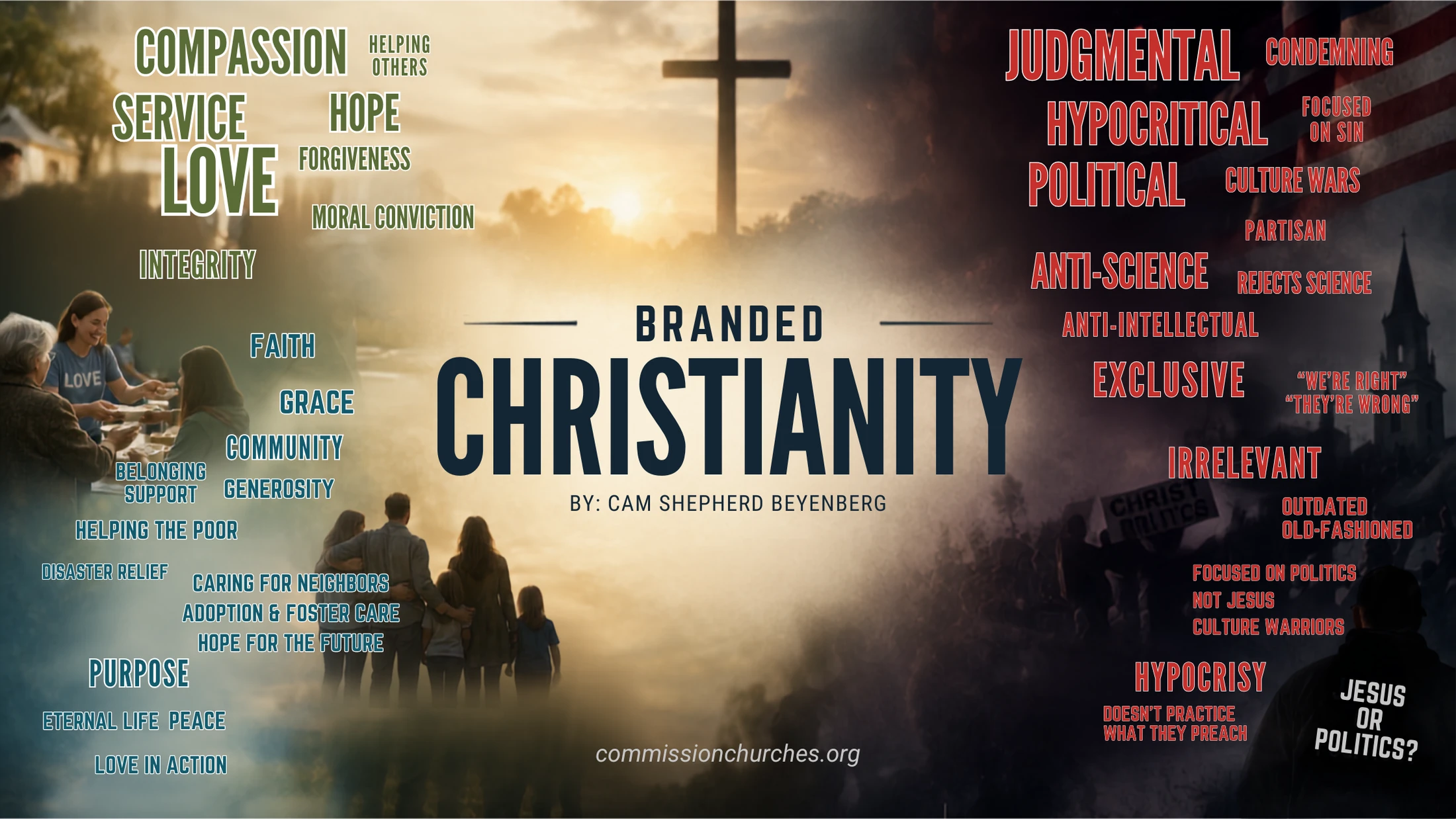
Branded Christianity
By: Cam Shepherd Beyenberg
We are all familiar with brands. From McDonald's arches to Apple’s apple to Nike’s swoosh, we see brands all the time that help us to identify a company and influence a certain feeling or perception about that company. After all, that’s what a brand is: a unique design, name, symbol, or feature that pinpoints a seller’s goods or services and helps to shape an overall feeling about the group.
Whether we know it or not, we are influenced by brands every day. These logos, groups, and names shape us to think, speak, and act in line with their perceived image. For example, many fast food restaurants use yellow and red because these colors are associated with hunger. Or Disney uses a cursive and free-flowing font connected with their castle to spark childhood wonder and warmth. Mercedes-Benz has a three-pointed star inside a circle to evoke luxury, precision, and status.
The brands we see and hear each day are consistently inspiring us to think, feel, and act accordingly. The founder of Amazon, Jeff Bezos, said it this way: “Your brand is what other people say about you when you’re not in the room.”
Now, I bring all of this up to ask one question: what is Christianity’s brand? When we look at the core message of Christianity, it is founded on the Gospel of Jesus. It is a message of God’s power and grace to create all things, faithfully love all of creation, offer redemption and forgiveness of sin, and invite all of creation into eternal life expressed through love for God and love for others.
As beautiful as this good news is, many people do not experience this story when they think of Christians. In fact, 7 out of 10 active churchgoers believe that the public perception of Christians in America is negative. However, according to Pew Research Center and Barna Research, about 53% of Americans have a positive or neutral view of Christians. For the other 47% who view Christians negatively, many of them blame it on things like partisan divide, Christian nationalism, and mismatched beliefs and behaviors.
In other words, Christianity has a “branding problem”. What people experience from Christians is not what they hear about as the foundational premise of Christianity. What people see and hear from Christians they know is causing them to associate a certain feeling or belief toward the rest of Christians.
Now, I’m not saying whether people are right or wrong in their perception. I’m just saying that they have a perception. About 87% of non-Christians view Christians as being judgmental (Barna Research). Other perspectives include Christians being elitist, exclusive, and hypocritical. That’s bad branding. It’s especially bad branding when non-Christians hear or read the message of our Savior, but then experience another message from those in His Church.
And this is nothing new. In fact, Christians were seen as crazy and suspicious in the first century according to Roman officials. Although they provided stability throughout the dark and medieval times, they were also met with criticism because of power abuses and corruption. The church was viewed as divided, broken, and dangerous during the Reformation era. And in our modern times, world leaders have commented openly against Christians. The freedom fighter and influential Indian leader, Mahatma Gandhi, once said, “I like your Christ, I do not like your Christians. Your Christians are so unlike your Christ.”
I believe those words should shake us to our core. Your Christians are so unlike your Christ. Ouch. To be a Christian is to be like Christ. The word Christian actually originated as a slang term that non-believers used to make of believers in the first century (Acts 11:26). It was a way in which certain groups of people would label others as little versions of whoever they followed (Pompeians, Augustianians, etc.). In other words, believers in Jesus were called “little Christs”, and even though it was an insult at first, it was a proper nickname for them.
As Christians, our “brand” is the Christ. The symbol, name, and main feature of Christianity is Christ Jesus. His birth, teachings, commandments, miracles, life, death, and resurrection all shape not only His followers but the overall feeling and perception of His followers and Him. This matters because the branding problem at hand is not about us trying to sell Jesus to others; it’s more so about our witness. If we are not truly living as little Christs, others will hear or see one message, but experience something else altogether. Their experience and perception will ultimately reveal what they believe about the “brand”.
I write all of this to say that I believe there are some important branding shifts that the church in America needs to adopt. I believe the Scriptures are clear, particularly in the New Testament, about the importance of living a life that imitates Christ and allows the world around us to see the truth of Jesus. In fact, this is what Paul focuses on in his writings to the churches in Corinth, Galatia, and Rome. He offers course corrections to their divisions, disagreements, and sinful actions toward one another that ultimately are witnesses to the non-believers around them. The American church can learn from these calls to prioritize our unity, witness, and love for God and others.
I would like to suggest the following statements as an exhortation for us to receive and express.
Christians follow Christ Jesus. They do not add other beliefs or syncretize with the cultural norms around them. (Mt. 16:24; Jn. 14:6; Col. 2)
Christians are changed by Jesus. They do not seek transformation through the sinful, broken, and anti-God methods of the world. (Mt. 4:19; Rms. 12:1-2)
Christians are committed to the mission of Jesus. They are called to be loved by God, to love God, to love people, and to make disciples. Everything else flows from their primary calling and commitment to Jesus’ love and mission. (Mt. 22:36-40; Mt. 28:18-20; Jn. 13:34-35)
Christians are not political parties. We do not follow the donkey or elephant; we follow the Lamb. (Jn. 18:36; Phil. 3:20; Rev. 19:11-16)
Christians are not consumers of the commercialization of the age. Christians consume the body and blood of Jesus and are empowered to live radically generous lives detached from the materialistic ways of this world. (Jn. 6:53-58; Mt. 6:19-24; 1 Tim. 6; Acts 2:42-47)
Christians are not judges that exclude certain groups or people from the Gospel. They are saved by grace, and they are servant leaders who humbly serve and welcome others in love. (Eph. 2:8-10; Rom. 1-2, 15:7; Jms. 2:1-13; Mk. 10:42-45)
Christians are not oppressors of others, acting in protection of their own wealth and possessions. They are compassionate towards all, caring for the marginalized, and engaging with justice and mercy in our world. (Mic. 6:8; Is. 58:6-12; Jms. 1:27; Lk. 4:18-19)
Christians are citizens of heaven first. Our identity as God’s beloved is more important than any other identifying factor. (Phil. 3:20-21; 1 Pet. 2:9-12; Gal. 3:26-29; 1 Jn. 3:1-3)
Christians are not escapists, waiting to be swept away at Jesus’ return. Christians are invited to pray for God’s Kingdom to come on earth as it is in heaven and live in such a way that the world experiences heaven through our lives. (Mt. 6:9-10; 2 Cor. 5:20; Rev. 21-22)
Christians are not powerless or hopeless. Christians are full of hope that anchors our soul. No matter what happens around us, God is still on the throne, and He is already at work in making all things new, right, good, and as they ought to be. (Heb. 6:19; Rom. 8:18-39 + 15:13; Rev. 21:1-15)
Imagine what the perception would be of Christianity if we not only believed these truths, but also embodied and expressed them through our lives. The “brand” of Christianity would not be that Christians are unlike Christ, but rather that Christians look like Jesus.
And here’s the truth: the brand of Christianity isn’t supposed to shift to being normal. Christians are not normal. We are weird. We are not of this world, and our practices are supernaturally empowered by a Risen Savior. We are the weirdos that do, think, and say things that cause others to look at us differently. And that’s a good thing.
So, let us be those who do not abide by the known brand in this world. Let us not just wear the shirts or hats, or post verses in our captions and bios but not live them out. Let our lives be a living billboard that looks like Jesus.
Perhaps if our branding issues shifted from hypocritical, judgmental, and exclusive to those weirdos who look like Jesus, we would have a message that lines up with the experience of it. And maybe, just maybe, we’d have a different problem altogether: how do we make more room for more weirdos who want to follow and look like Jesus? Let’s focus on that. Amen.