
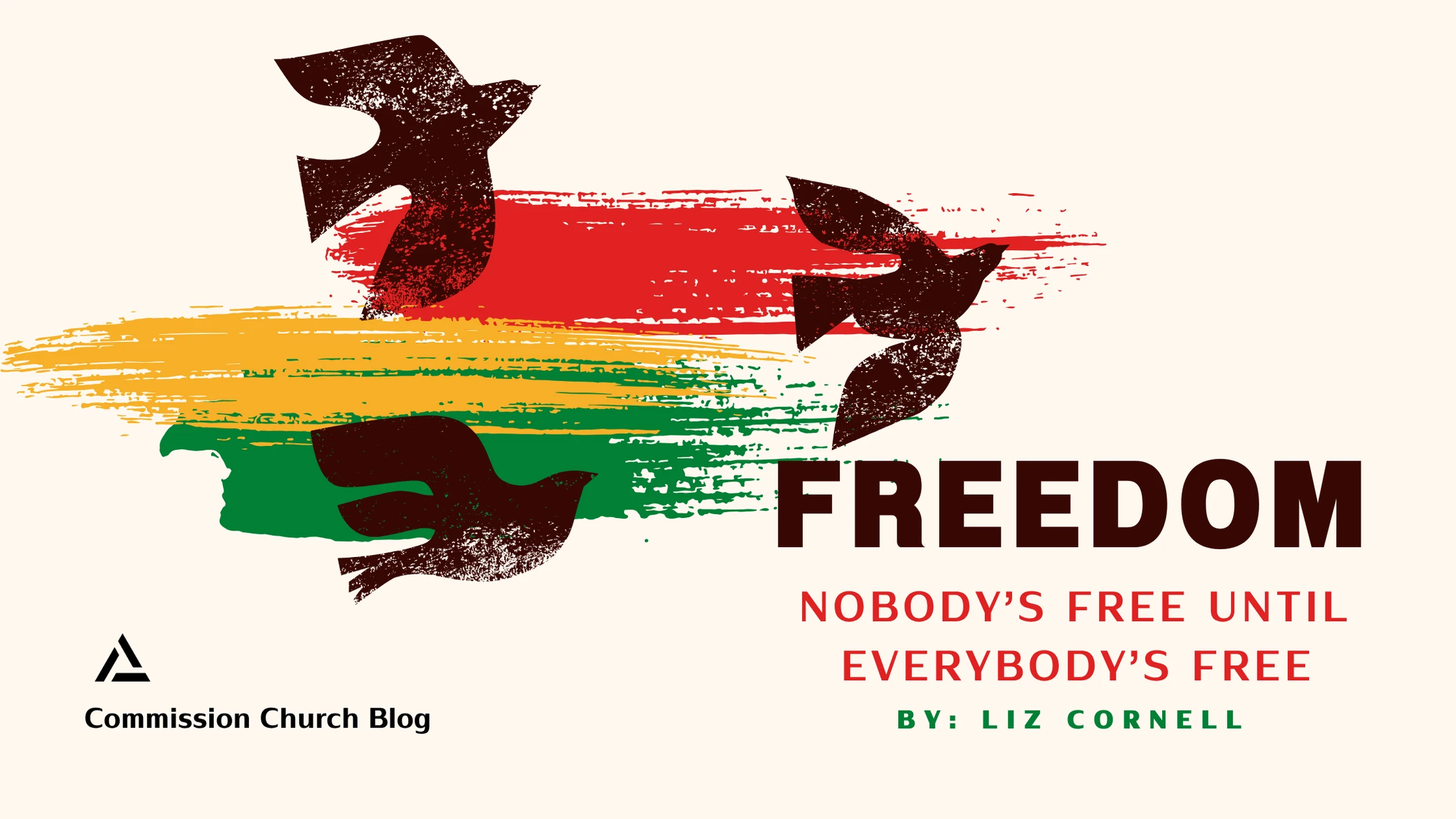
Freedom: Nobody's Free Until Everybody's Free
Ah summer, a time of freedom! We get to shed our winter clothing and spend our days outside. Children and students are freed from the obligations of school. Many of us take long-anticipated family vacations, and we celebrate our freedom as Americans with the 4th of July and Juneteenth (June 19h).
I know that to some it seems odd that as a country we have decided to include Juneteenth as part of our celebrations of freedom. I grew up with the 4th of July parade, speeches, BBQ, and fireworks as the absolute observance of our American liberty. (I remember a friend of mine in high school saying that as far as celebrations go, it was better than Christmas.) But I would contend that while the 4th of July celebrates the wonderful idea of American freedom, Juneteenth celebrates the beginning of it becoming a reality for all. Juneteenth should be seen not as a distraction from the 4th of July but as an extension of it.
In 1971, civil rights activist Fannie Lou Hamer famously said, “Nobody’s free until everybody’s free.” I believe this to be true, and I believe that our country’s history reflects an understanding of that truth while at the same time engaging in an ongoing struggle to make freedom an enduring reality for everyone.
Let me explain…
The 4th of July celebrates the inception of the United States of America through its Declaration of Independence from Britain. In many ways, the Declaration of Independence is an awe-inspiring and beautiful document. It sets out the foundations for our democracy and has been instrumental in shaping democratic movements globally. In the preamble, Thomas Jefferson instituted the concept of citizens’ rights and provided its moral justification by writing:
“We hold these truths to be self-evident, that all men are created equal, that they are endowed by their Creator with certain unalienable Rights, that among these are Life, Liberty and the pursuit of Happiness.”
These are truly remarkable words that reflect a Christian understanding of the imago Dei in all people. That is, all human beings are created in the image of God and should be afforded the dignity of a life without tyranny, the liberty of self-governance, and the opportunity to pursue a virtuous and moral life.
Unfortunately, though, when Jefferson wrote about “all men” being created equal, he was only referring to white landowning men. In Jefferson’s time, the majority of the signers of the Constitution (including Jefferson) owned Black slaves, women’s rights were severely limited, and even white men with no property had limited civil rights. In other words, the concept of freedom and civil liberty in 1776 only applied to certain people.
This created a disconnect between the stated ideals of freedom in our country and the realities of oppression experienced by many. Nowhere was this more painfully clear than in the 3/5ths Compromise of the U.S. Constitution, which held that enslaved people were considered to be only 3/5ths of a person. We can understand, then, what would motivate Frederick Douglas (a man who escaped slavery in 1838 and went on to become a leader in the abolitionist movement) to write a speech titled, “What to a Slave is the Fourth of July?” In this speech, Douglas spoke about the gross hypocrisy between the country’s stated values of liberty and the reality of slavery.
23 years after Douglas’ speech, the country went to war when the South seceded from the Union primarily over the issue of slavery. In 1863, Abraham Lincoln issued the Emancipation Proclamation, which freed people who were held in bondage in “rebellious” states (those states which remained in the Confederacy). Unfortunately, enslaved people in States which had remained in the Union were not freed by this proclamation, meaning not “all men” were free yet.
The 13th Amendment was passed by the Senate in 1864 and by the House of Representatives in December of 1865. The Civil War ended in May 1865. Because of the lag of communication at the time, it wasn’t until June 19, 1865, that the last of the country’s enslaved people were freed in Texas. Thus, Juneteenth has become a celebration of the day on which all enslaved people became free.
Nobody’s free until everybody’s free...
I think it’s a fair question to ask ourselves: Is everybody free now? In the 1960s, we had the Civil Rights Movement because even though all of our citizens were theoretically free, civil rights and liberties were curtailed through legalized segregation and discrimination. The Civil Rights Act of 1964, the Voting Rights Act of 1965, and the Civil Rights Act of 1968 have all worked to secure civil rights protections for all Americans.
So, do we finally have it right? Is everyone free yet? Can we confidently celebrate everybody’s freedom? Some would argue (myself included) that we still have a ways to go. Today, we struggle with issues over mass incarceration, unfair immigration policies, racial profiling, and misuse of power by law enforcement.
To be clear, I’m not saying that our country should be dismantled and burned to the ground or even that I don’t love it. Far from it – I love our democratic ideals, and I believe in them. What I am saying is that we need to strive to live up to those ideals. Even though we have done so imperfectly (sometimes very imperfectly) in the past, we should never lose sight of seeking justice, dignity, and equality for all. The reality is that this is the both/and of living in a fallen world which has been redeemed by Christ while waiting for the time when all things will be made right and God’s will to be done on earth as it is in heaven.
As you enter into the freedom of summer, I encourage you to embrace our country’s ideals of freedom while recognizing that our history has fallen short (sometimes very short) of those ideals. I encourage you to take an honest and prayerful look at where we have been and where we still need to go. And I encourage you to promote justice, dignity, and equality for all in whatever context you may find yourself.
Friends, we can love and celebrate our country while courageously looking at our past and seeking to make it a better place for all because…Nobody’s free until everybody’s free, and we should all be free.